The Hanged Man
The Hanged Man represents suspension, a change in perspective, and a different relationship with movement. The pause may be chosen or experienced as a limitation; the reading needs to explore that difference. The card does not force sacrifice nor acceptance of a damaging situation.
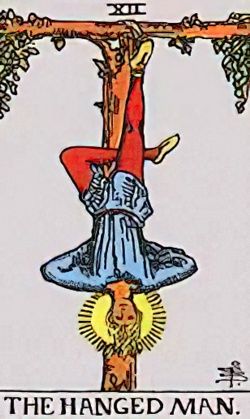
What to notice in the image
The suspended figure on one foot in Rider-Waite-Smith inverts the usual orientation of the body. Its posture and the halo introduce a contrast between immobility and attention. See what is visible from that angle, without assuming that stopping is always the appropriate answer.
Nuances of interpretation
Suspension can allow understanding something that haste was hiding. It can also become procrastination if it is never reviewed for its purpose. When using reversals, explore resistance to changing one's view or difficulty leaving the pause. The image does not establish deadlines.
An example with other cards
With The Emperor, The Hanged Man, and The Magician, a work situation can be read between structure, blockage, and a concrete initiative. The question is what scope of action appears when looking at the conditions differently. The synthesis does not promise that the organization will change by itself.
A question for your reading
What changes when viewing the situation from another angle, and what still requires action?