Follow the Moon’s rhythm and take a moment to observe the sky and write down your own questions.
Eight phases to follow the Moon
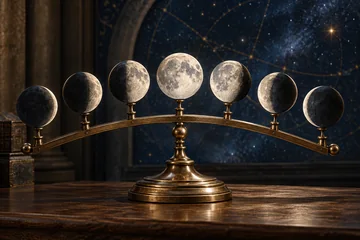
The Moon reflects sunlight. During its cycle, the illuminated portion we see from Earth changes. New Moons are about 29.5 days apart on average; the phases follow a continuous progression.
New Moon: the visible disc is almost unlit. Waxing crescent: a slim illuminated shape grows. First quarter: roughly half the disc appears lit. Waxing gibbous: the illuminated portion exceeds half and continues to grow.
Full Moon: almost the entire disc appears illuminated. Waning gibbous: the visible light begins to decrease. Last quarter: roughly half the disc appears lit again. Waning crescent: an increasingly thin shape remains before the next new Moon.
How to read this calendar
Check the time zone and use the arrows to move to the previous or next month. The “Today” card keeps showing the current phase, illumination and Moon sign even while you browse another month. The two upcoming-event cards also count forward from now.
Each small Moon represents 12:00 in the selected zone. A main-phase label and its time mark a different instant within that day. For example, if a full Moon is marked at 22:00, the noon picture still represents a few hours earlier. Illumination is rounded and the phase name summarises part of the cycle: it does not mean the entire day is the exact full-Moon instant.
Times are approximate. You can browse months from 1900 to 2100; historical time offsets, particularly before 1970, may carry uncertainty. The calendar does not calculate moonrise or visibility from your location.
A symbolic cycle for your journal
Astrology and various contemporary practices use the cycle as an image of beginning, development, review and closure. These are symbolic associations: they do not require you to feel a particular emotion or guarantee a successful decision on a given date.
Try a journal page for a small project: at new Moon, write an intention; while the Moon waxes, note a possible step; at full Moon, review what happened; while it wanes, decide what to adjust or leave behind. If you need to act today, there is no need to wait for another phase. The calendar accompanies reflection; you choose the pace.
Frequently Asked Questions
Why can the date change when I choose another time zone?
A main phase occurs at one instant, but each zone expresses it with its own date and time. An event at 23:30 UTC may already fall on the next day elsewhere. Changing the zone does not change the astronomical phase; it changes the civil time and the instant used to represent noon in each daily cell.
Does the Moon look the same in both hemispheres?
The phase is the same at a given instant, but its apparent orientation depends on place and time. The calendar drawings are schematic and do not rotate for your location. Avoid treating “lit on the right” or “lit on the left” as a universal rule for distinguishing waxing from waning.
What does “Moon in” a sign mean?
It indicates the Moon’s current position in the tropical zodiac, divided into twelve 30-degree sectors. Sign and phase describe different things: zodiacal position and illumination. This is not your birth Moon sign or a personal prediction. To explore the Moon at birth, open the Moon-sign calculator.
Does a full Moon make me sleep worse?
Studies of lunar phases and sleep have produced different results: some observe associations, while others find no significant effect. This calendar cannot predict how you will sleep or explain a poor night on its own. If you keep a record, include schedules, habits and circumstances too; coincidence does not establish a cause.
Can I use it to choose when to plant or harvest?
Gardening by lunar phases and signs is a tradition. Consistent evidence does not support promising better harvests from following those rules. This tool does not account for species, climate, soil or watering. You can record the phase as a cultural reference without making it a guarantee about your plants.
Does it recommend diets, fasting or haircuts?
No. Associations between phases and cleansing, weight loss or hair growth are popular beliefs, not recommendations derived from lunar calculations. The calendar does not determine when your body needs food, rest or care. The journal suggestions are reflection exercises, without dietary or treatment instructions.
Does a full Moon mean there will be an eclipse?
No. A lunar eclipse requires the Moon to pass through Earth’s shadow; that alignment does not occur at every full Moon. The calendar marks phases but does not identify eclipses, supermoons or personal lunar returns. Earth’s shadow is not what causes the ordinary phases.
Do I need my birth details or artificial intelligence?
Not to use this calendar: positions and phases are calculated in the browser. The guide is editorial text and its examples are symbolic. No personalised reading is generated and your history is not analysed. Birth charts and birth Moon signs are separate tools.