The High Priestess
The High Priestess represents listening, reserve, and a knowledge that requires time to be articulated. Its silence does not equate to a hidden answer that the card can reveal: it opens a relationship between what you perceive, what you know, and what you have not yet expressed.
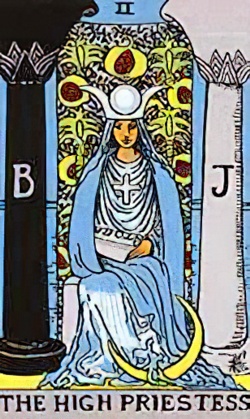
What to notice in the image
In the Rider–Waite–Smith image, the seated figure, two pillars, veil and scroll suggest different thresholds of understanding. Some things are visible; others remain covered. This contrast can help you explore privacy or learning without treating each detail as a secret with one fixed solution.
Nuances of interpretation
Calmness can favor attention and depth; taken to the extreme, it can become isolation or indefinite waiting. A position or an adjacent card helps distinguish these nuances. If it appears reversed in a variation that uses reversals, explore the difficulty of listening or expressing something, without attributing secrets to other people.
An example with other cards
Alongside The Magician and Temperance, The High Priestess can invite adjusting an initiative through observation and dialogue. A work conversation, for example, might need to better formulate the question before attempting to solve it. The combination relates silence, action, and measure; it does not confirm that there is hidden information.
A question for your reading
What is the difference between needing more time and leaving something important unexpressed?