The Wheel of Fortune
Wheel of Fortune represents variation, cycles, and changes of position. It allows you to explore how one responds to what is moving, without promising good luck or stating that everything is predestined. The card gains nuance by relating changing circumstances and the capacity for adaptation.
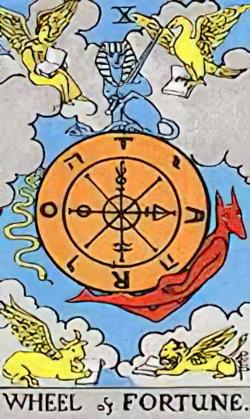
What to notice in the image
The central wheel of Rider-Waite-Smith is surrounded by figures and symbols. Its circular shape highlights return and movement; the environment introduces distinct points of observation. Look at what changes place and what seems to remain as a framework before reducing the image winning or losing.
Nuances of interpretation
Change can open possibilities and also disorient. An inverted reading can explore resistance, repetition, or difficulty in finding rhythm, if the variant uses inversions. The combination with cards of structure or measure allows you to ask how to accompany variation without attributing an external intention to it.
An example with other cards
With The Emperor, Wheel of Fortune, and Temperance, a query about resources can connect a base, a changing circumstance, and a way to adjust the exchange. The example describes a symbolic relationship with stability; it does not calculate future money nor advise on an economic operation.
A question for your reading
What is varying and what part of your foundation do you wish to preserve while changing?