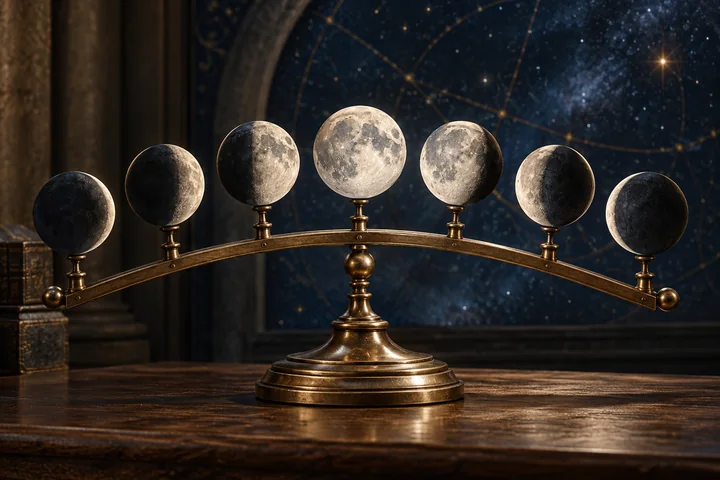
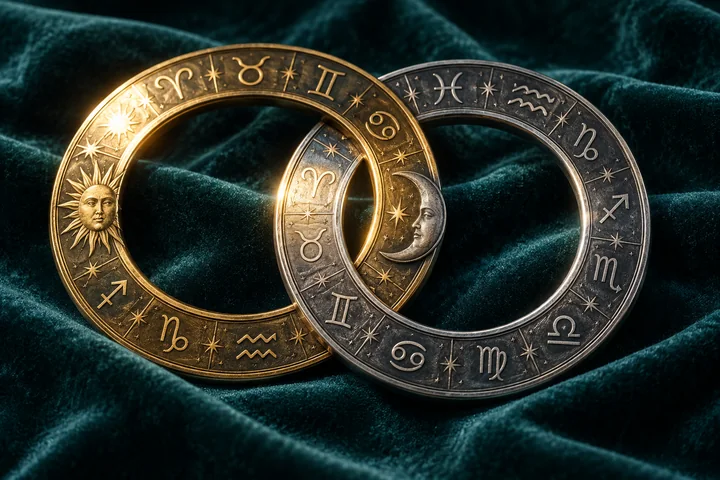
Moon sign. Take a quiet moment with the symbols of your birth. Calculate the result and explore a reading you can connect with your own experience.
What you can explore
Your Moon sign corresponds to the position of the Moon at birth. Its symbolic interpretation focuses on emotional comfort, patterns of care and ways of receiving experience. The reading offers an image and an example to consider alongside your own life. It does not infer your childhood or explain a particular day’s mood on its own.
Preparing your reading
Begin with your birth date. If you know the time, add both hour and minute with a city or a known UTC offset. Without a time, the tool checks the interval compatible with that day; without a location, it widens the interval to cover different time zones. If the sign changes during it, the possibilities are shown instead of an arbitrary choice.
An example to guide your reading
With a Gemini Moon, consider whether talking or writing helps organise an experience. You might ask: “Am I explaining what I feel, or also giving it space?” If several signs are possible, keep that uncertainty until you can add information; identifying with a text does not establish the Moon’s actual position.
Frequently Asked Questions
Why are two or more signs possible?
The information entered leaves a time interval during which the Sun or Moon may change signs. Each alternative is shown with its interpretation. Adding time, minute and city may narrow the calculation; choosing your favourite description does not resolve uncertainty about the birth.
What if I do not know my birth time?
A birth chart and Ascendant require a time; do not invent one or routinely use noon. You can check the Sun and Moon separately without a time: those tools show the signs compatible with the available information. If you later find a more precise record, you can complete the reading.
How are clock changes handled?
The city’s historical time offset is applied. A time that occurred twice requires you to select one occurrence; a time that never occurred is rejected so you can check it. Pre-1970 records may carry historical uncertainty. Do not add another daylight-saving hour yourself when it has already been applied.
Can correcting a few minutes change the result?
It can near a sign boundary, particularly for the Ascendant. There is no fixed number of minutes that always guarantees the same result. Degrees are approximate and coordinates represent the city centre; the tool flags positions very close to a boundary.
Who writes the interpretation?
Positions are calculated from your information, and interpretations come from an editorial catalogue of the twelve signs. These four tools do not need AI to prepare a reading. Two readings with the same signs receive the same texts; the examples are symbolic and do not know your personal history.
Can I save and compare my results?
Once the result is ready, use the button to save it in “My readings”. You can reopen it, add notes and download it as text. Records stay in this browser; use the library’s downloadable backup before clearing browser data or moving to another device.