LABORATORY FOR PARAPSYCHOLOGY · EST. 1930

1 / 25
?

Test your extrasensory ability with Zener cards. Do you have telepathy or precognition? Find out for free.

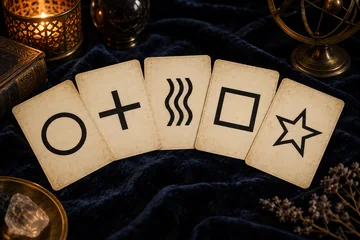
The Zener Test measures your extrasensory capacity using the five classic cards from J.B. Rhine's experiment at Duke University (1930): circle, cross, waves, square and star. If you guess more cards than statistics would predict by chance, you may have a measurable psychic ability. This app applies the original protocol with results you can verify against the probabilities.

What is the Zener Test?

The test was developed by Karl Zener in collaboration with the renowned parapsychologist J.B. Rhine in the 1930s. Rhine wanted to study extrasensory perception (ESP) with scientific methodology: standardised cards, five simple symbols, thousands of statistical trials. His results — some subjects appeared to score consistently above chance — launched parapsychology as an academic discipline.

The protocol is simple: the operator (or the computer) selects a card at random and the subject attempts to "guess" it using psychic abilities: telepathy (if someone is looking at it), clairvoyance (if it is hidden) or precognition (if it has not yet been drawn). Statistically, you should be right 1 in every 5 times (20%). If you score above that consistently, there is a deviation that merits attention.

The Five Symbols

The symbols chosen by Zener are geometrically distinct and emotionally neutral: circle (unity), cross (intersection of forces), three waves (movement), square (stability), five-pointed star (synthesis). Emotional neutrality matters because some symbols (heart, skull) might generate unconscious preference that would skew the experiment.

In the test, you try to perceive the symbol before seeing it. Some methods: closing your eyes and "seeing" it mentally, feeling it in the body, waiting for a name to arise in the mind. There is no "correct" method; each psychic develops their own. What matters is a sustained accuracy rate over many trials, not isolated correct guesses.

Frequently Asked Questions

What accuracy rate means I have psychic ability?
By pure chance, you should be right 20% of the time. If you score 25–30% consistently across many tests (not just one), the deviation is statistically significant. Scores above 35–40% in long series are extraordinarily high results that deserve attention. A single short test can yield any result by chance; what matters is the pattern.
Is ESP proven science?
Controversial. Rhine and many subsequent parapsychologists reported statistically significant results in large meta-analyses. But replicating the effect consistently and eliminating all alternative explanations (information leakage, experimenter bias) has proved difficult. Parapsychology remains an active academic discipline but without consensus on the reality of ESP.
How do I train my psychic ability?
Some methods reported by practitioners: regular meditation (which sensitises subtle perception), daily practice of the test without anxiety about results, keeping a diary of intuitions and checking how accurate they are, deep relaxation before each attempt. The ability seems to improve with practice, though not equally in all subjects.
What if my results are very poor (worse than chance)?
Curiously, this is also statistically significant. If you consistently score below 15%, the negative deviation may suggest a phenomenon called psi-missing: your unconscious "avoids" the correct answer. It is usually associated with resistance to believing in the paranormal, or with a very adverse emotional state during the test.